VB-2012
Available now
In the workshop 21 days
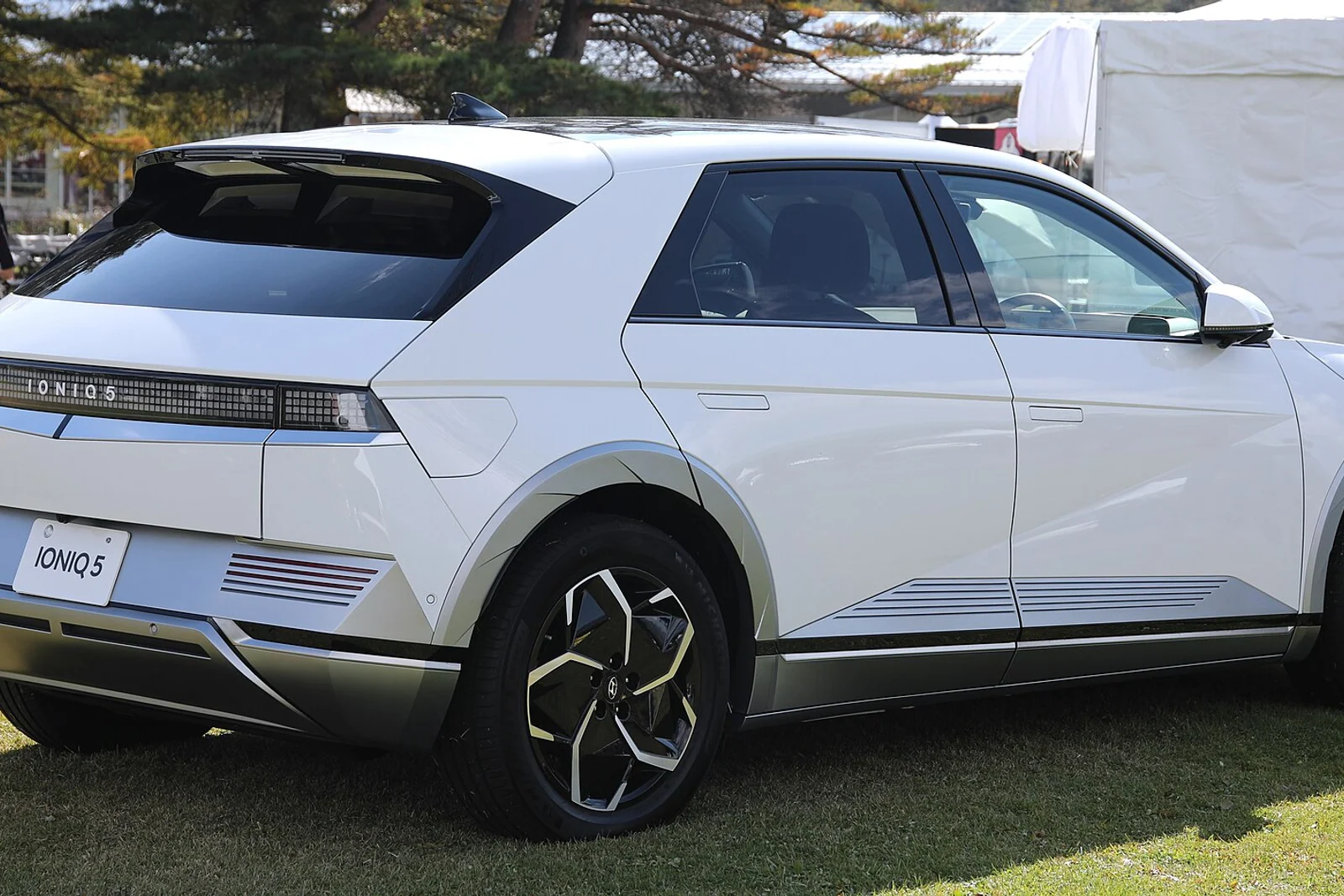
2022 Hyundai Ioniq 5 SEL AWD

Asking price
$23,900
vs market
+ 4%
Range, rated against measured
Measured on our 60-mile mixed loop, September, 88 °F. Winter in a northern state costs another 15–25%.
Battery report
97% of new capacity
- Battery & BMS 97
- Drive units 96
- Suspension 93
- Brakes & regen 94
- Body & paint 95
- Interior 94
- Software & charging 95
Charging
232 kW peak
10–80% takes about 18 minutes on a charger that can supply 232 kW or more.
Onboard AC charger 10.9 kW — a full night on a 240 V wall unit
Battery replacement
$16,800
Current cost of a replacement pack or module set for this model, fitted. We publish it so you can do the arithmetic before you buy, not after.
10 years / 100,000 miles on the battery — transfers
Running cost
3.3 mi/kWh
Efficiency from the EPA rating and usable battery capacity. At Florida electricity prices that is about $4 per 100 miles of home charging — roughly a third of what a petrol equivalent costs to run.
Service costs are lower too: no oil, no belts, and brake wear is halved by regenerative braking.
Condition
95/100
Seven measured systems, including the battery and the charging hardware. Red-flag items are either corrected before listing or written into the defect log with the price consequence stated.
Among the best-conditioned cars on the lot.
2 findings, published
1 moderate
- Moderate Integrated Charging Control Unit campaign 24V-868, which supersedes 24V-204 New remedy completed: unit, fuse and software. Paperwork in the file
- Note Charge port door slightly stiff in cold weather Lubricated
Specification
KM8KN4AE•••••207
- Stock
- VB-2012
- Battery
- 77.4 kWh · health 97%
- EPA range
- 256 mi
- Measured range
- 244 mi (September, 88 °F)
- DC charging
- 232 kW · 10–80% in 18 min
- Onboard charger
- 10.9 kW AC
- Power
- 320 hp · 446 lb-ft
- 0–60 mph
- 4.5 s
- Drive
- AWD · 5 seats
- Curb weight
- 4,464 lb
- Odometer
- 23,840 mi
- Exterior
- Atlas White
- Interior
- Dark gray cloth
- VIN (masked)
- KM8KN4AE•••••207
- Title
- Clean · Florida, in hand
- Previous owners
- 1
- Days on lot
- 21
Service history
2 records
- Battery health cycle, 18-minute 10–80% DC run logged 23,840 mi · In-house bay
- ICCU campaign 24V-868 — charging unit and fuse replaced, software updated 19,200 mi · Hyundai dealer
Highlights
- 18 minutes from 10 to 80% — the fastest charging car on the lot
- Vehicle-to-load output measured at 1.8 kW on our test bench
- Battery recall campaign closed with dealer paperwork
Inspector's notes
256-mile EPA rating is the AWD figure; the rear-drive version is rated 303. This one is AWD and we price it as such.
The ICCU recall is the known weak point on this platform; ours is done under the current campaign number, not the superseded one, and the paperwork proves it.
Battery is listed at 77.4 kWh, the figure Hyundai publishes; independent testing puts usable capacity nearer 72.6 kWh.
Hyundai advertises 350 kW charging for this platform, but the car accepts about 232 kW — the 18-minute figure is real, the 350 is the charger.
Verified data
Factory figures, checked.
Range, efficiency, battery capacity, charging power and dimensions come from the manufacturer and the EPA rather than from a listing aggregator. Where a figure could not be verified we leave it out and say so.
Manufacturer & EPA
- Battery
- 77.4 kWh pack — Hyundai publishes one figure; independent estimates put usable near 72.6 kWh
- EPA range
- 256 mi (long-range AWD)
- EPA efficiency
- 98 MPGe combined · 110 city / 87 highway
- DC fast charging
- 232 kW peak measured on a 350 kW charger — 10–80% in 18 minutes
- Onboard charger
- 10.9 kW AC — 10–100% in 6 h 43 min
- Power
- 320 hp · 446 lb-ft (dual-motor AWD)
- 0–60 mph
- 4.5 s (Car and Driver instrumented test of an AWD car)
- Curb weight
- 4,464 lb — Hyundai gives 4,464–4,662 lb across all AWD cars
- Drive
- AWD · 5 seats · 0.85 cu ft front trunk
- Cargo
- 27.2 cu ft behind the second row (59.3 folded), excluding the frunk
- Dimensions
- 182.5 in long · 74.4 wide · 63.0 high · 118.1 in wheelbase (width without mirrors)
- NHTSA overall
- 5 stars
Model watch list
What this generation is known for.
Documented faults for this exact year and powertrain, listed whether or not this particular car shows them — the recall or service bulletin is named so you can check it yourself.
- Integrated Charging Control Unit can fail and stop charging the 12-volt battery, causing loss of drive power — recall 24V-868 (campaign 272), 145,000+ cars, replacing recall 24V-204; remedy is an ICCU and fuse replacement plus software
- The ICCU dominates owner complaints rather than being an isolated fault: 221 of the 405 NHTSA complaints for the 2022 car mention it, including cars that refuse AC charging while still accepting DC
- Because 24V-204 was superseded, a car repaired under the earlier campaign still needs the new remedy — ask for the campaign number on the invoice, not just the word recall
- Shifter Control Unit software error can let the parking mechanism disengage and the car roll away — recall 22V-324 (campaign 228)
Notes on the data
- Hyundai advertises 350 kW charging capability on this 800 V platform, but the car itself accepts about 232 kW, which is the number that decides how long you stand there.
- The 18-minute 10–80% time is on an 800 V charger; the same sheet gives 25 minutes on the older 150 kW hardware.
- The ICCU recall is the defining risk on this generation, and an early repair is not enough: the original campaign was superseded and cars fixed under it must be redone.
- At about 35,000 miles, US asks for a 2022 Ioniq 5 run roughly $20,000–$26,000, with SEL AWD being the second-from-top 2022 configuration.